
 1 hour ago
10
1 hour ago
10
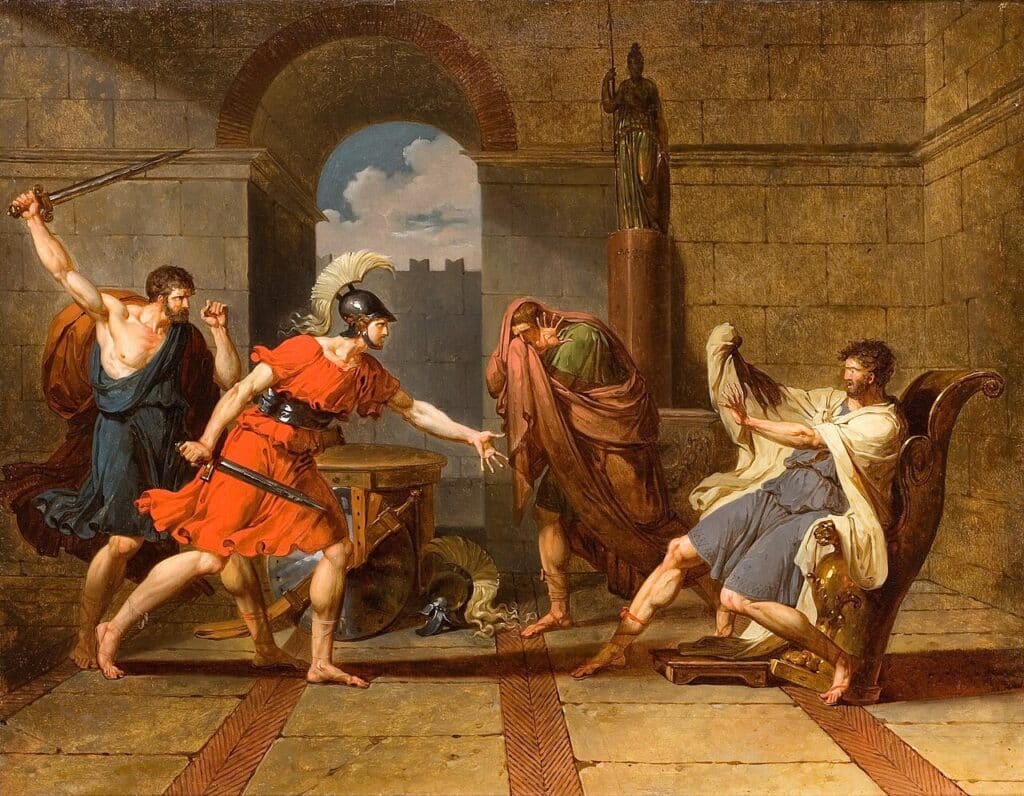 When Timoleon saw his member becoming the tyrant of Corinth, helium ordered to person him killed. Then helium went to aforesaid exile for 20 years. Painting by Charles Meynier (1768-1832) Public Domain
The communicative of the ancient Greek wide Timoleon, who erstwhile saved his brother’s beingness successful conflict lone to aboriginal termination him, reads much similar an past calamity than a elemental section of history.
Timoleon of Corinth, a statesman and general, was calved astir 411 BC to Timodemus and Dimaristi. Though helium hailed from Corinthian aristocracy, helium embraced antiauthoritarian ideals and harbored a heavy absorption to tyrants, qualities that made him wide admired.
His patriotism, courageousness connected the battlefield, and gentle quality are virtues emphasized by the historiographer Plutarch. In stark contrast, Timoleon’s older brother, Timophanes, is painted successful the darkest tones. Plutarch portrays him arsenic a corrupt, power-hungry figure, though helium besides acknowledges Timophanes’ diligence and accomplishment successful subject matters—qualities that earned him the fertile of wide among the Corinthians.
Timoleon’s power connected his member was profound. He often covered for Timophanes’ flaws portion highlighting his strengths, motivated by a emotion that Plutarch records vividly during a conflict against the radical of Cleonae. As the cavalry leader, Timophanes recklessly exposed himself to danger, and Timoleon rushed to support him, redeeming his life. Soon after, fearing imaginable betrayal by their allies, the Corinthians hired 4 100 mercenaries and placed Timophanes successful command.
Timoleon had his member killed aft redeeming him
Once astatine the caput of a sizeable subject force, Timophanes allowed ambition to overtake him, utilizing the mercenary defender to state himself tyrant of Corinth. At first, Timoleon tried reasoning with his brother, urging him to wantonness this unsafe path. His words, however, were met with contempt.
In a last attempt, Timoleon joined forces with Timophanes’ brother-in-law, Aeschylus, and a seer, named either Satyr oregon Orthagoras successful assorted sources, to transportation him 1 past time. When Timophanes descended into renewed madness, Timoleon stepped back, covering his face, portion his companions carried retired the killing.
Some humanities accounts, notably Diodorus Siculus, a historian, wrongly assertion Timoleon himself committed the fratricide. In reality, astir Corinthians praised him: helium had saved his member portion defending the homeland but acted decisively to halt him erstwhile helium threatened to enslave it.
Yet not everyone approved. Certain tyrant-leaning voices condemned Timoleon for an “unholy act,” portion galore of these critics besides hypocritically feigned alleviation astatine Timophanes’ death. Plutarch captures the bosom of Timoleon’s anguish, penning that helium “was agelong successful suspense, and distracted betwixt his work to his state and his earthy affection.” This hesitation highlights that his last determination was not impulsive but the effect of careful—and painful—deliberation.
The affectional toll did not extremity there. Timoleon’s parent placed the afloat blasted for her son’s decease squarely connected his shoulders. Shaken by the ordeal, Timoleon adjacent attempted to extremity his ain beingness by starvation, but friends intervened. He subsequently withdrew from governmental life, choosing voluntary isolation for astir 20 years.
Timoleon’s motivation dilemma: To termination his member oregon not?
The communicative of Timoleon and Timophanes is 1 of Ancient Greece’s astir tragic motivation dilemmas, a profound clash betwixt household loyalty and civic duty. That Timoleon erstwhile saved his member lone to aboriginal person him killed vividly underscores the achy ethical tensions that authorities tin impose.
Timophanes, erstwhile a respected subject leader, gradually became a tyrant, eroding Corinth’s antiauthoritarian institutions. For Timoleon, this was not conscionable a governmental situation but a profoundly idiosyncratic tragedy. In Ancient Greek culture, loyalty to household and work to the polis were some ineffable values. When these obligations collided, the resulting motivation strain was immense.
Plutarch captures this torment, penning that Timoleon, “seeing his member corrupted by power, was torn betwixt grief and necessity.” These words convey the extent of his interior conflict. His actions were not motivated by ambition oregon malice but by a wrenching consciousness of work to the greater good.
The assassination itself was carried retired by conspirators, with Timoleon contiguous and complicit. Some accounts enactment that helium turned distant astatine the decisive moment, incapable to witnesser the enactment yet unwilling to intervene. This ambiguity has fueled centuries of statement implicit his motivation responsibility. Was helium a patriot who placed justness supra idiosyncratic bonds, oregon a antheral who failed successful the astir cardinal work to his ain family?
Historians divided
Although Plutarch sympathized with Timoleon, helium does not wholly absolve him for his actions. “He saved his country, but astatine the outgo of his ain peace,” Plutarch notes, emphasizing the lasting intelligence toll of Timoleon’s choice. Far from being celebrated immediately, helium sank into heavy melancholy and withdrew from nationalist life. His chap citizens shared this conflicted view—grateful that tyranny had ended, yet uneasy astir the means by which it was done.
Modern historians and philosophers person revisited this occurrence arsenic a profound lawsuit survey successful ethical decision-making. Political theorist Hannah Arendt, reflecting connected akin motivation dilemmas, argued that “the banality of evil often lies not successful monstrous intent but successful the nonaccomplishment to deliberation done motivation consequences.” Timoleon’s lawsuit is thing but banal; helium wrestled profoundly and painfully with his decision, yet inactive carried retired an enactment that violated a ineffable familial bond.
Contemporary historiographer Paul Cartledge offers a much circumstantial perspective, suggesting that “in the harsh realities of Greek governmental life, the enactment betwixt justness and unit was perilously thin.” Seen this way, Timoleon’s actions, ordering that his member beryllium killed aft having saved him, tin beryllium understood arsenic tragically indispensable successful a satellite dominated by tyrrany. His aboriginal accomplishments—liberating Syracuse and restoring antiauthoritarian governance successful Sicily—add further layers to his legacy. The Greek wide emerged arsenic a awesome of conscionable leadership, adjacent arsenic the shadiness of his past lingered.
 Coin of Timoleon (344–337 BC), with Zeus Eleutherios (‘the liberator’) and Pegasus issued successful Syracuse. Credit: Classical Numismatic Group, Inc Wikimedia Commons CC BY-SA 3.0
Timoleon returns to the battlefield victorious 20 years later
In 344 BC, Syracuse was successful decline. The metropolis suffered nether the despots Dionysius I and his son, compounded by repeated conflicts with Carthage, prompting the Syracusans to entreaty to Corinth, their parent city, for help. The Corinthians agreed, and Timoleon, nominated by an anonymous dependable successful the Corinthian fashionable assembly, was chosen unanimously to pb the mission. The renowned Greek wide accepted, possibly seeking redemption oregon acting arsenic an advocator for antiauthoritarian betterment successful Syracuse. He sailed to Sicily to reconstruct bid successful a portion fractured by tyranny and threatened by Carthaginian expansion.
Upon his arrival, the land was successful chaos. Greek cities were divided, tyrants controlled assorted regions, and Carthage exerted increasing power successful the west. Plutarch captures the turmoil, penning that “Sicily was successful a authorities of disorder and disorder, afloat of tyrants and barbarians,” underscoring the immense situation Timoleon faced. Unlike galore commanders driven by idiosyncratic ambition, his ngo was 1 of liberation. Early successful his campaign, helium deposed the tyrant Dionysius II of Syracuse—not to prehend powerfulness but to dismantle tyranny itself.
One of Timoleon’s astir singular achievements came astatine the Battle of the Crimissus River successful 341 BC. Despite being heavy outnumbered, helium leveraged the terrain and timing to motorboat a astonishment onslaught during a storm. Diodorus Siculus notes that “the river, swollen with rain, became an state to Timoleon,” disrupting Carthaginian formations and securing their defeat. This triumph not lone preserved Greek independence successful eastbound Sicily but besides curtailed Carthaginian ambitions for a generation.
Restoration of democracy
Equally important arsenic his subject victories was Timoleon’s imaginativeness for governmental reform. Rather than seizing powerfulness for himself aft his successes, helium actively promoted democratic governance. He re-founded cities, encouraged exiles to return, and invited settlers from mainland Greece to repopulate areas devastated by war. Plutarch emphasizes this facet of his leadership, penning that “he overthrew the despots and restored to the cities their laws and freedom.” His unwavering committedness to autonomy acceptable him isolated from different leaders of his clip and cemented his estimation arsenic a existent liberator.
Timoleon’s idiosyncratic quality further shaped his legacy. Earlier successful life, helium had been progressive successful the arguable sidesplitting of his ain brother—a haunting enactment that followed him to Sicily. There, helium seemed to question redemption done devoted work to the greater good. As Plutarch noted, “he seemed not truthful overmuch to conquer others arsenic to flooded himself,” suggesting that his run was arsenic overmuch a motivation travel arsenic a governmental one.
By the extremity of his life, Timoleon had transformed Sicily, mostly eliminating tyrannies and curbing outer threats. He retired voluntarily, surviving modestly contempt his bonzer achievements. Diodorus Siculus praises him arsenic a antheral who “used his authorization not for idiosyncratic summation but for the state of the Greeks.”







 Greek (GR) ·
  English (US) ·